POTENTIAL FOR LIFE ON SATURN MOON
By Laurence A. Marschal
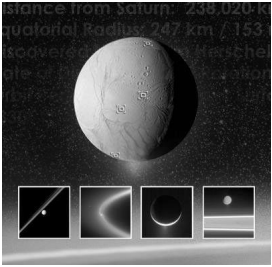
As indicated in recent analyses, the conditions on Saturn’s icy moon Enceladus make it a prime target in the search for extraterrestrial life. Observed in detail by NASA’s Cassini mission in 2005, this “natural” satellite (so called because it orbits Saturn) is distinguished by numerous icy cryovolcanoes that eject towering plumes [nuvens] of water vapor, ice particles, and organic molecules into space, with much of the material falling back to the moon’s surface. Those organic molecules may include a subcategory known as biomolecules, which are the fundamental building blocks of life and are essential for the structure and function of living cells.
The geologic activity of Enceladus implies that an ocean of liquid water, as deep as six miles [9.65 kilometers], lies hidden beneath the ice. As with Jupiter’s moon Europa (which also has an ice-covered ocean), the water on Enceladus may be habitable, but unlike Europa, no drilling would be required to investigate further. Due to the activity of Enceladus’s cryovolcanoes, evidence of biomolecules in its oceans could be detected via a straightforward mission to sample the surface residue of its plumes.
As researcher Christopher H. House, at the Pennsylvania State University in State College, PA, has emphasized, “It is aweinspiring [impressionante, extraordinário] to think that with known technology, we can readily [facilmente] access lots of organic material from a possibly habitable extraterrestrial ocean.”
Adapted from Natural History, March 2024
With respect to the search for signs of life, how does Enceladus most likely differ from Jupiter’s moon Europa?
Lê-se em: “As with Jupiter’s moon Europa (which also has an ice-covered ocean), the water on Enceladus may be habitable, but unlike Europa, no drilling would be required to investigate further.”